How corridors, not countries, are defining the new geography of economic gravity. As the multilateral trading order fragments and supply chains restructure, integrated systems of ports, rail, digital infrastructure, and regulatory alignment are replacing national borders as the primary units of economic analysis.
By Aleksander Meidell-Hagewick
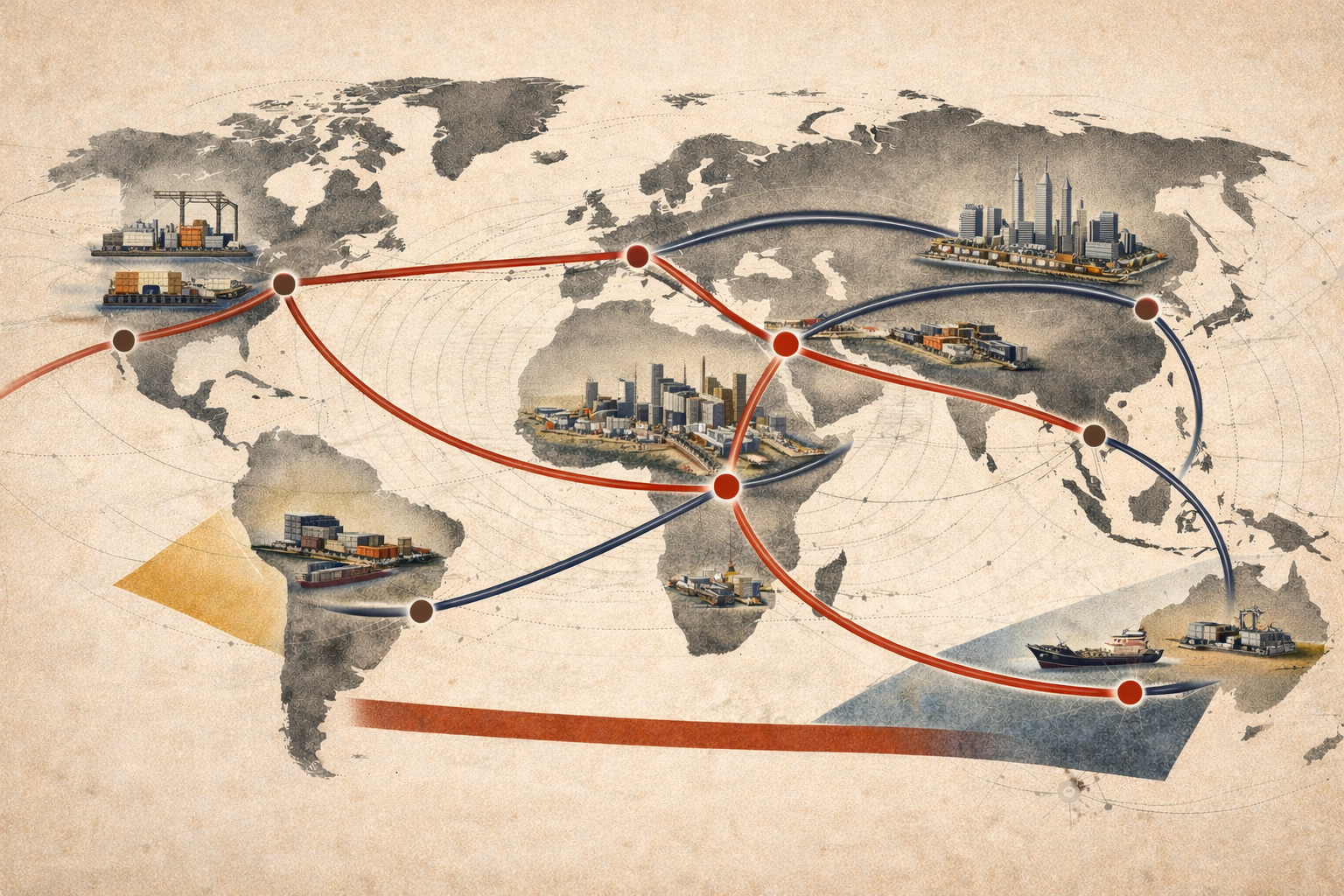 How corridors, not countries, are defining the new geography of economic gravity
In 2024, DP World handled a record 88.3 million containers across terminals spanning six continents, equivalent to roughly one in every ten containers moved anywhere on earth. The same year, freight volumes along the Trans-Caspian Middle Corridor surged by more than 60 per cent. Meanwhile, the Red Sea crisis forced the wholesale rerouting of Asia to Europe shipping around the Cape of Good Hope, adding 3,500 nautical miles and ten or more days to every voyage. These are not isolated logistics stories. They are symptoms of a structural transformation in how the global economy organises itself.
For most of the twentieth century, the dominant unit of economic analysis was the nation state. GDP, bilateral trade balances, and comparative advantage were all measured country by country. That framework is becoming insufficient. The fastest growing economic relationships are no longer defined by national borders or even by bilateral agreements. They are defined by corridors: integrated systems of ports, rail, roads, digital infrastructure, free zones, and regulatory alignment that connect production to consumption across multiple sovereign boundaries. Economic gravity, the force that determines where capital accumulates and where strategic leverage resides, is migrating from countries to corridors.
Three interlocking forces drive this shift. First, the fragmentation of the multilateral trading order is eroding the predictability that once made rules based commerce reliable, pushing states to secure access through physical infrastructure rather than institutional guarantees. Second, the restructuring of supply chains after the pandemic and successive rounds of sanctions is generating demand not just for alternative suppliers but for alternative pathways. Third, the emergence of capital rich middle powers with the resources and strategic intent to anchor corridor systems is accelerating construction on a historically unusual scale.
1. The Surface Picture: Trade Is Moving, but Where?
Shifting flows, shifting gravity
The raw numbers signal a world in motion. Global merchandise trade reached a record $33 trillion in 2024, up 3.7 per cent from the previous year, according to UN Trade and Development. But the composition and routing of those flows is changing fast. South to South trade, commerce between developing economies, accounted for just 9 per cent of global trade in 2004. By 2023, that share had risen to 20 per cent, and the trend is accelerating. Intra-Asian trade now comprises nearly 60 per cent of the Asia-Pacific region's total exports. China-ASEAN bilateral trade reached nearly $1 trillion in 2024, up from under $200 billion in 2008. Gulf Cooperation Council trade with emerging Asia is projected to rise from $450 billion in 2023 to $680 billion by 2030, with GCC to China trade expected to surpass combined GCC trade with the United States, the United Kingdom, and Western Europe by 2027.
These are not merely larger volumes flowing along familiar routes. The routes themselves are changing. Middle Corridor freight through Central Asia jumped 86 per cent year on year in 2023, and Kazakh rail volumes rose a further 63 per cent in 2024. New deep water ports are under construction in Senegal, the Democratic Republic of Congo, and Ecuador. The Gulf states are building integrated logistics platforms linking sea, air, rail, and road networks into seamless multimodal systems. A cumulative $106 trillion in global infrastructure investment is projected by 2040, according to McKinsey, with transportation and logistics alone requiring $36 trillion, the single largest category.
Why the national lens falls short
Traditional trade analysis, built around bilateral balances and national competitiveness indicators, struggles to capture what is actually happening. Consider a container of cobalt mined in the Democratic Republic of Congo, railed to an Atlantic port, shipped to a Gulf refining hub, processed into battery grade material, and re-exported to a Southeast Asian electronics manufacturer. The value created at each stage accrues not to any single country in proportion to its GDP, but to whichever nodes along the corridor extract margin through their position in the chain. The corridor, not the country, is the unit that determines where value concentrates.
This mismatch between the analytical framework and the underlying reality has practical consequences. Investors who allocate capital based on national GDP growth may miss the fact that a mid-sized economy positioned at a corridor intersection is capturing disproportionate value. Policymakers who think in bilateral terms may underestimate how deeply their economy's fortunes depend on infrastructure decisions made in neighbouring states. The corridor lens does not replace country level analysis, but without it, the picture is materially incomplete.
2. Root Drivers: Why Corridors, Why Now?
The fragmentation of the multilateral trading order
The rules based trading system that underpinned globalisation for decades is fraying. The WTO's latest monitoring data paints a stark picture: imports worth $2.64 trillion, or 11.1 per cent of total global imports, were affected by new tariffs and other restrictive measures introduced in the twelve months to mid-October 2025. This was more than four times the $611 billion recorded in the preceding period, and represents the largest increase in the fifteen year history of WTO trade monitoring. The accumulated stockpile of import restrictions in force now covers nearly 12 per cent of global trade, up from under 10 per cent just a year earlier.
This is not merely a US and China story, though that rivalry is the most visible driver. Export restrictions are gaining momentum globally, covering $277 billion in traded goods. The number of regional trade agreements has swelled to more than 360 in 2023, up from just 22 in 1990, as states pursue bilateral and plurilateral guarantees in place of multilateral ones. Research from the Bank for International Settlements finds that trade values between geopolitically distant economies grew roughly 12 percentage points more slowly than between closer ones from 2017 to 2023. The Banque de France's fragmentation index shows that since Russia's invasion of Ukraine, trade between opposing geopolitical blocs fell by 15 per cent relative to trade with neutral countries, while intra-bloc trade rose by about 5 per cent.
The causal mechanism is straightforward: as multilateral norms become less reliable, states seek alternative forms of insurance. Physical infrastructure—a port, a rail link, a logistics zone governed by a bilateral framework—offers a more tangible guarantee of market access than a WTO ruling that may never be enforced. Corridors are, in this sense, the physical manifestation of declining institutional trust. They represent a shift from rules based trade to infrastructure based trade, where access is secured not by legal right but by physical connection.
Supply chain restructuring as a structural force
The pandemic and the subsequent cascade of sanctions and export controls have fundamentally changed how firms and governments think about supply chains. The shift is often described as "reshoring" or "nearshoring," but these terms are misleading in their simplicity. What is actually happening is rerouting: the construction of alternative pathways that provide redundancy without sacrificing the efficiency gains of global production networks.
The Red Sea crisis has made this logic visceral. Since Houthi attacks began disrupting shipping in late 2023, Suez Canal transits have fallen by as much as 90 per cent for container traffic. By May 2025, tonnage through the Suez Canal was still 70 per cent below 2023 levels, according to UNCTAD. The Cape of Good Hope route has become the default for Asia to Europe container traffic, adding a 30 per cent increase in transit times that J.P. Morgan estimates reduced effective global container shipping capacity by approximately 9 per cent. Freight premiums of 25 to 35 per cent above pre-crisis levels have persisted into 2025.
The response has not been to retreat from global trade but to build alternative corridors. The Middle Corridor through Central Asia has attracted billions in investment from the EU, China, and multilateral development banks, despite an estimated €6.5 billion funding gap in infrastructure. The development of land bridge corridors connecting South Asia to European markets through the Middle East has accelerated. New port infrastructure on Africa's Atlantic and Indian Ocean coasts is being designed explicitly to offer routing alternatives.
The demand is not just for alternative suppliers but for alternative pathways, and pathways require corridors.
Infrastructure as strategic competition
A third root driver is the transformation of infrastructure from a development tool into a strategic asset. Multiple competing connectivity initiatives now span the globe. China's infrastructure programme is estimated to approach $1 trillion in cumulative spending. The EU's Global Gateway has allocated €300 billion. The G7's Partnership for Global Infrastructure and Investment targets $600 billion. Gulf sovereign wealth funds, which collectively manage nearly $6 trillion in assets (more than 40 per cent of the global total), deployed $82 billion in 2023 and a further $55 billion in the first nine months of 2024. There has been a decisive pivot toward hard assets: infrastructure and real estate comprised 61 per cent of total SWF investments in 2024, the first time in a decade that these sectors surpassed equity allocations.
The mechanism here is competitive escalation. When one major power invests in a port or rail link, rival powers face pressure to fund alternatives lest they cede influence along that corridor. This dynamic accelerates corridor formation beyond what pure commercial logic would dictate. States now view ports, rail links, fibre optic cables, and logistics zones not merely as economic assets but as instruments of alignment, and the competition to provide them is creating a historically unusual abundance of infrastructure capital seeking deployment in corridor shaped projects.
3. How the System Works: Causal Mechanisms and Feedback Loops
The Connectivity Premium
The most important dynamic in corridor economics is a reinforcing feedback loop that can be termed the Connectivity Premium. The mechanism operates as follows: infrastructure investment along a corridor reduces transit costs and times; lower friction attracts higher trade volumes; higher volumes generate revenue, data, and agglomeration effects; these in turn justify further investment, which deepens the corridor's advantage over alternatives. Once a corridor reaches critical mass, it becomes progressively cheaper and faster than competing routes, creating a self reinforcing cycle that is extremely difficult to reverse.
The evidence for this loop is emerging in real time. Saudi Arabia's single window digital customs platform, Fasah, cut average clearance times from seven to twelve days to approximately two hours. The UAE's Jebel Ali Free Zone generated AED 713 billion ($194 billion) in non-oil trade in 2024, a 15 per cent increase over the prior year. Corridor adjacent port expansions across the GCC, from Saudi Arabia's SR640 million ($170.5 million) expansion of Jeddah Islamic Port to Qatar's Hamad Port reaching over 2 million TEU capacity, are generating the throughput volumes that attract further shipping line calls, which in turn attract further investment. Historical precedent is instructive: the Suez Canal corridor, the Rhine-Danube system, and the Strait of Malacca ecosystem all demonstrate how early connectivity advantages compound over decades.
The Node Effect: where value concentrates
Not all points along a corridor capture equal value. The critical variable is node positioning: the degree to which a location sits at a corridor intersection, serves as a regulatory gateway, or provides processing and re-export functions that add margin. Nodes benefit from agglomeration effects. The more functions concentrated at a single point (customs clearance, warehousing, processing, financial services, digital logistics platforms), the harder it becomes to bypass.
This is where the Gulf's structural position becomes most consequential. The GCC states sit at the intersection of the Europe to Asia, Africa to Asia, and energy export corridors, with one third of the world's population living within four hours' flight. They are not merely transit points; they are investing heavily in the value adding node functions (free zones, refining capacity, logistics platforms, digital trade facilitation) that capture the highest margins along a corridor. Saudi Arabia held 53 per cent of the GCC contract logistics market in 2024, backed by over SR1 trillion ($267 billion) in planned logistics spending under Vision 2030. Gulf port operators now manage terminals across six continents, extending their corridor influence far beyond the region itself.
The Institutional Lock-In Loop
A second reinforcing loop operates at the institutional level. As corridor traffic grows, the states along it develop bilateral regulatory frameworks: customs harmonisation agreements, mutual recognition of standards, coordinated digital clearance systems, and authorised economic operator programmes. These institutional arrangements raise the switching costs for firms and shipping lines, further entrenching the corridor's position. The UAE-India Comprehensive Economic Partnership Agreement, the upgraded ASEAN-China Free Trade Agreement signed in late 2025, and the GCC's unified transit system for cross border trucking are all examples of institutional architecture being layered onto physical infrastructure, creating path dependencies that will persist for decades.
This loop is particularly significant because it means corridors are not merely physical; they are regulatory and institutional. And institutions, once constructed, resist change. A firm that has invested in compliance with a corridor's regulatory framework, trained staff in its digital systems, and built warehousing at its nodes faces substantial costs in switching to an alternative route. The corridors being built and institutionalised now will shape trade patterns long after the current geopolitical moment has passed.
The balancing force: chokepoint vulnerability
Against these reinforcing loops, a balancing dynamic operates. Every corridor concentrates risk as well as value. The Red Sea crisis demonstrated this with clarity: a single chokepoint disruption redirected an estimated 15 per cent of global maritime trade virtually overnight. The Panama Canal drought of 2023 to 2024 imposed further constraints, reducing daily crossings by roughly half. Disruption losses in 2024 were estimated at 7 per cent of global GDP according to the World Economic Forum, approximately $3.18 trillion.
This vulnerability creates demand for corridor diversification: when one route is disrupted, alternatives become more valuable, and investment flows to build them. But the balancing force is weaker than the reinforcing loops. Building a new corridor takes years and billions of dollars; redirecting traffic to an existing alternative takes days. The net effect is a system that concentrates around a relatively small number of major corridors, punctuated by periodic disruptions that trigger bursts of investment in alternatives.
4. Amplifiers and Complicating Factors
Digital infrastructure as a corridor accelerator
Physical corridors are increasingly twinned with digital ones, and the digital layer amplifies the Connectivity Premium by further reducing friction. Fibre optic submarine cables, data centres, fintech payment systems, blockchain based cargo tracking, and AI driven demand forecasting are all being deployed along major corridors. McKinsey estimates that $19 trillion in digital infrastructure investment will be required globally by 2040, the fastest growing infrastructure category relative to its current scale, driven in part by AI related demand.
The GCC states are particularly active in this domain. Sovereign wealth funds invested $9.4 billion in digital infrastructure across 53 deals in 2024, including $5.4 billion in data centres and telecommunications, a 54 per cent rise from 2023. Southeast Asia invested over $30 billion in AI infrastructure in 2024 alone. The states that combine physical and digital corridor infrastructure gain a compounding advantage: real time logistics optimisation, automated customs clearance, and integrated supply chain visibility reduce costs further, attract more traffic, and deepen the Connectivity Premium.
Commodity rerouting as a forcing function
Energy transition, sanctions driven rerouting of oil and gas, and the scramble for critical minerals are creating new physical flows that demand new corridors. Commodities are heavy, physical, and route dependent. They must flow through infrastructure, giving corridor controllers significant leverage. The rerouting of Russian energy exports, the growth of Gulf to Asia refining corridors, and the race to secure African critical mineral supply chains all follow corridor logic. The Lobito Corridor investment programme has attracted over $5 billion in committed finance for rail, road, and agricultural infrastructure linking Angola, the DRC, and Zambia. The physical geography of commodity production and consumption imposes a structural demand for corridor infrastructure that pure digital trade cannot replace.
Capital allocation follows connectivity
Sovereign wealth funds, development finance institutions, and increasingly private capital are allocating along corridor logic, creating a further amplifying effect. Gulf SWFs deployed $82 billion in 2023, with a marked shift toward corridor relevant assets. The International Forum of Sovereign Wealth Funds reports that investment in "resilient infrastructure" (transportation, utilities, and digital infrastructure) overtook energy in 2024 to become the largest single category of sovereign sustainable investment. Capital flows are also regionalising: SWF investment along the Middle East to Europe and Middle East to Africa corridors has intensified, while global cross continental deals have fallen to a historic low of 15 per cent of sustainable deal value.
This is both an outcome (capital follows the trade flows that corridors create) and an amplifier (capital investment deepens the corridors further). The pattern is self reinforcing: as corridor trade volumes grow, they generate the return profiles that attract institutional capital, which funds the next phase of infrastructure, which attracts more trade. The GCC's sovereign wealth funds are particularly significant here. With nearly $6 trillion in collective assets under management and a strategic intent to diversify beyond hydrocarbons, they have the scale, the geographic position, and the investment mandate to shape corridor development at a global level.
The complication: corridors cross fragile states
Many of the most strategically important corridors run through states with weak governance, conflict risk, or institutional fragility. The Middle Corridor traverses countries where trade dropped 37 per cent from 2022 to 2023 due to bottlenecks and logistical failings, leading businesses to revert to traditional routes. The Lobito Corridor faces the challenge that road infrastructure in remote mining regions remains inadequate, and privatisation has shifted railway priorities toward mineral exports at the expense of local agricultural trade. African corridors contend with security costs, governance gaps, and competing political interests that can stall or reverse infrastructure progress.
This creates a structural tension. Corridor logic demands long term, stable infrastructure investment with predictable returns over decades. But the political environments along many emerging corridors are anything but stable. Security provision along corridors—who provides it, under what authority, at what cost—is an underexamined variable that could prove decisive in determining which corridors consolidate and which falter.
5. Leverage Points, Scenarios, and What Comes Next
Three leverage points
Hub positioning at corridor intersections is the single highest leverage variable in this system. States that control the nodes where major corridors intersect capture disproportionate economic and strategic value. The Gulf is the most consequential current example, sitting at the crossing point of East to West and North to South trade flows, with the capital and institutional capacity to invest in node infrastructure. But East African port cities, Central Asian transit states, and Southeast Asian logistics hubs are also vying for node status along emerging corridors.
Regulatory and standards convergence is a second leverage point that is often underestimated. Corridors with harmonised customs, digital clearance, and mutual recognition of standards outperform those without, regardless of the quality of physical infrastructure. The institutional architecture layered on top of a corridor (trade agreements, customs unions, digital trade facilitation platforms) can be as important as the rail and ports beneath it. The African Continental Free Trade Area, ratified by 49 of 54 signatory states, represents the world's largest free trade area by number of countries and, if fully implemented, could be the most significant corridor enabling institutional development of the decade.
Digital corridor integration constitutes the third leverage point. The firms and states that build the digital layer (logistics platforms, payment systems, data infrastructure) on top of physical corridors will capture a growing share of corridor value over time. As AI driven optimisation, real time tracking, and automated clearance systems reduce friction further, the digital layer may become more valuable than the physical infrastructure it sits upon.
Three scenarios
Scenario A: Corridor Consolidation (assessed as most likely). Three to five major corridor systems solidify over the next decade, each anchored by one or more capital rich hub states. The Gulf emerges as the pre-eminent East to West connectivity node. Southeast Asia deepens its intra-Asian corridor role. East Africa becomes a contested but growing corridor anchor. Trade increasingly flows along these established corridors, with the Connectivity Premium and Institutional Lock-In loops making them progressively harder to displace. Capital allocation, logistics infrastructure, and regulatory architecture all reinforce consolidation. The risk in this scenario is concentration: a small number of corridors carrying a large share of global trade creates systemic vulnerability.
Scenario B: Corridor Fragmentation (possible). A major geopolitical escalation, whether conflict, severe sanctions, or a prolonged chokepoint disruption, fractures one or more major corridors. States scramble to build alternatives, but the cost and time required mean a period of reduced connectivity and higher friction. The IMF estimates that extreme trade fragmentation could reduce global output by as much as 7 per cent over the long term, equivalent to roughly $7.4 trillion in today's terms, more than three times sub-Saharan Africa's annual output. This scenario is costly but may ultimately produce a more resilient, if less efficient, global trading system.
Scenario C: Digital Corridor Leapfrog (emerging). Advances in digital trade facilitation, autonomous logistics, and fintech reduce the importance of physical corridor infrastructure relative to digital connectivity. States with strong digital infrastructure but weaker physical connectivity gain ground. Digitally delivered services exports, already growing at over 6 per cent annually according to WTO projections, could partially decouple economic gravity from geographic corridor positioning. But physical goods still require physical routes, limiting the extent of the shift. This scenario is most relevant for services heavy economies and least relevant for commodity exporters.
Signals to monitor
Several observable indicators would help distinguish which scenario is unfolding. Volume and frequency data at key corridor nodes (port throughput, rail freight tonnage, air cargo volumes) provide the most direct measure of corridor consolidation. Sovereign wealth fund and development finance institution capital allocation patterns reveal whether institutional capital is following corridor logic. Regulatory harmonisation agreements between corridor states signal institutional lock-in. Chokepoint disruption events and the speed and direction of rerouting test corridor resilience. And digital infrastructure investment along corridor routes (fibre optic deployment, data centre construction, fintech integration) indicates whether the digital leapfrog scenario is gaining traction.
Conclusion: The Map Is Being Redrawn
At its core, the shift from countries to corridors as the primary units of economic gravity is driven by two root forces: the fragmentation of the multilateral trading order, and the restructuring of supply chains after successive disruptions. These root forces are amplified by strategic infrastructure competition and capital allocation patterns that follow connectivity logic. The result is a self reinforcing system. Corridors that attract investment attract trade, which attracts further investment, creating path dependencies that will shape the economic map for decades. The Connectivity Premium and Institutional Lock-In loops compound this effect, while chokepoint vulnerability provides an imperfect but real balancing force that drives demand for redundancy and diversification.
The Gulf's structural position—geographic centrality at the intersection of major East to West and North to South corridors, combined with capital surpluses that dwarf most national infrastructure budgets, and a strategic intent to anchor corridor systems—makes it one of the primary beneficiaries of this shift. But the advantage is not automatic. It depends on continued investment in both physical and digital node infrastructure, regulatory frameworks that reduce friction for corridor users, the management of security risks along extended corridor systems, and the institutional capacity to sustain partnerships with the diverse range of states through which corridors pass. The GCC's non-oil economy grew a robust 3.7 per cent in 2024, and the IMF projects GCC growth averaging 3.5 per cent in 2025 and 4.2 per cent in 2026, exceeding the global average. Whether that growth momentum becomes structurally embedded depends, in significant part, on whether the corridor strategy delivers.
What remains genuinely uncertain is whether the current corridor building moment produces a stable, consolidated map or a fragmented, contested one. The trajectory of great power competition, the frequency and severity of chokepoint disruptions, the pace of digital trade facilitation, and the willingness of corridor states to sustain the institutional cooperation that makes corridors function: these are the variables that will determine outcomes. The causal architecture is clear; the endpoint is not.
The economic map of the twenty first century is being redrawn not by the rise and fall of nations but by the construction of corridors. Understanding where those corridors run, who controls the nodes where they intersect, and which feedback loops are strengthening or weakening is becoming one of the most consequential analytical questions for investors, policymakers, and strategists. The countries that recognised this shift earliest, and invested accordingly, are already capturing its rewards. Those that continue to think in purely national terms risk finding themselves bypassed by a map they did not help to draw.
How corridors, not countries, are defining the new geography of economic gravity
In 2024, DP World handled a record 88.3 million containers across terminals spanning six continents, equivalent to roughly one in every ten containers moved anywhere on earth. The same year, freight volumes along the Trans-Caspian Middle Corridor surged by more than 60 per cent. Meanwhile, the Red Sea crisis forced the wholesale rerouting of Asia to Europe shipping around the Cape of Good Hope, adding 3,500 nautical miles and ten or more days to every voyage. These are not isolated logistics stories. They are symptoms of a structural transformation in how the global economy organises itself.
For most of the twentieth century, the dominant unit of economic analysis was the nation state. GDP, bilateral trade balances, and comparative advantage were all measured country by country. That framework is becoming insufficient. The fastest growing economic relationships are no longer defined by national borders or even by bilateral agreements. They are defined by corridors: integrated systems of ports, rail, roads, digital infrastructure, free zones, and regulatory alignment that connect production to consumption across multiple sovereign boundaries. Economic gravity, the force that determines where capital accumulates and where strategic leverage resides, is migrating from countries to corridors.
Three interlocking forces drive this shift. First, the fragmentation of the multilateral trading order is eroding the predictability that once made rules based commerce reliable, pushing states to secure access through physical infrastructure rather than institutional guarantees. Second, the restructuring of supply chains after the pandemic and successive rounds of sanctions is generating demand not just for alternative suppliers but for alternative pathways. Third, the emergence of capital rich middle powers with the resources and strategic intent to anchor corridor systems is accelerating construction on a historically unusual scale.
1. The Surface Picture: Trade Is Moving, but Where?
Shifting flows, shifting gravity
The raw numbers signal a world in motion. Global merchandise trade reached a record $33 trillion in 2024, up 3.7 per cent from the previous year, according to UN Trade and Development. But the composition and routing of those flows is changing fast. South to South trade, commerce between developing economies, accounted for just 9 per cent of global trade in 2004. By 2023, that share had risen to 20 per cent, and the trend is accelerating. Intra-Asian trade now comprises nearly 60 per cent of the Asia-Pacific region's total exports. China-ASEAN bilateral trade reached nearly $1 trillion in 2024, up from under $200 billion in 2008. Gulf Cooperation Council trade with emerging Asia is projected to rise from $450 billion in 2023 to $680 billion by 2030, with GCC to China trade expected to surpass combined GCC trade with the United States, the United Kingdom, and Western Europe by 2027.
These are not merely larger volumes flowing along familiar routes. The routes themselves are changing. Middle Corridor freight through Central Asia jumped 86 per cent year on year in 2023, and Kazakh rail volumes rose a further 63 per cent in 2024. New deep water ports are under construction in Senegal, the Democratic Republic of Congo, and Ecuador. The Gulf states are building integrated logistics platforms linking sea, air, rail, and road networks into seamless multimodal systems. A cumulative $106 trillion in global infrastructure investment is projected by 2040, according to McKinsey, with transportation and logistics alone requiring $36 trillion, the single largest category.
Why the national lens falls short
Traditional trade analysis, built around bilateral balances and national competitiveness indicators, struggles to capture what is actually happening. Consider a container of cobalt mined in the Democratic Republic of Congo, railed to an Atlantic port, shipped to a Gulf refining hub, processed into battery grade material, and re-exported to a Southeast Asian electronics manufacturer. The value created at each stage accrues not to any single country in proportion to its GDP, but to whichever nodes along the corridor extract margin through their position in the chain. The corridor, not the country, is the unit that determines where value concentrates.
This mismatch between the analytical framework and the underlying reality has practical consequences. Investors who allocate capital based on national GDP growth may miss the fact that a mid-sized economy positioned at a corridor intersection is capturing disproportionate value. Policymakers who think in bilateral terms may underestimate how deeply their economy's fortunes depend on infrastructure decisions made in neighbouring states. The corridor lens does not replace country level analysis, but without it, the picture is materially incomplete.
2. Root Drivers: Why Corridors, Why Now?
The fragmentation of the multilateral trading order
The rules based trading system that underpinned globalisation for decades is fraying. The WTO's latest monitoring data paints a stark picture: imports worth $2.64 trillion, or 11.1 per cent of total global imports, were affected by new tariffs and other restrictive measures introduced in the twelve months to mid-October 2025. This was more than four times the $611 billion recorded in the preceding period, and represents the largest increase in the fifteen year history of WTO trade monitoring. The accumulated stockpile of import restrictions in force now covers nearly 12 per cent of global trade, up from under 10 per cent just a year earlier.
This is not merely a US and China story, though that rivalry is the most visible driver. Export restrictions are gaining momentum globally, covering $277 billion in traded goods. The number of regional trade agreements has swelled to more than 360 in 2023, up from just 22 in 1990, as states pursue bilateral and plurilateral guarantees in place of multilateral ones. Research from the Bank for International Settlements finds that trade values between geopolitically distant economies grew roughly 12 percentage points more slowly than between closer ones from 2017 to 2023. The Banque de France's fragmentation index shows that since Russia's invasion of Ukraine, trade between opposing geopolitical blocs fell by 15 per cent relative to trade with neutral countries, while intra-bloc trade rose by about 5 per cent.
The causal mechanism is straightforward: as multilateral norms become less reliable, states seek alternative forms of insurance. Physical infrastructure—a port, a rail link, a logistics zone governed by a bilateral framework—offers a more tangible guarantee of market access than a WTO ruling that may never be enforced. Corridors are, in this sense, the physical manifestation of declining institutional trust. They represent a shift from rules based trade to infrastructure based trade, where access is secured not by legal right but by physical connection.
Supply chain restructuring as a structural force
The pandemic and the subsequent cascade of sanctions and export controls have fundamentally changed how firms and governments think about supply chains. The shift is often described as "reshoring" or "nearshoring," but these terms are misleading in their simplicity. What is actually happening is rerouting: the construction of alternative pathways that provide redundancy without sacrificing the efficiency gains of global production networks.
The Red Sea crisis has made this logic visceral. Since Houthi attacks began disrupting shipping in late 2023, Suez Canal transits have fallen by as much as 90 per cent for container traffic. By May 2025, tonnage through the Suez Canal was still 70 per cent below 2023 levels, according to UNCTAD. The Cape of Good Hope route has become the default for Asia to Europe container traffic, adding a 30 per cent increase in transit times that J.P. Morgan estimates reduced effective global container shipping capacity by approximately 9 per cent. Freight premiums of 25 to 35 per cent above pre-crisis levels have persisted into 2025.
The response has not been to retreat from global trade but to build alternative corridors. The Middle Corridor through Central Asia has attracted billions in investment from the EU, China, and multilateral development banks, despite an estimated €6.5 billion funding gap in infrastructure. The development of land bridge corridors connecting South Asia to European markets through the Middle East has accelerated. New port infrastructure on Africa's Atlantic and Indian Ocean coasts is being designed explicitly to offer routing alternatives.
The demand is not just for alternative suppliers but for alternative pathways, and pathways require corridors.
Infrastructure as strategic competition
A third root driver is the transformation of infrastructure from a development tool into a strategic asset. Multiple competing connectivity initiatives now span the globe. China's infrastructure programme is estimated to approach $1 trillion in cumulative spending. The EU's Global Gateway has allocated €300 billion. The G7's Partnership for Global Infrastructure and Investment targets $600 billion. Gulf sovereign wealth funds, which collectively manage nearly $6 trillion in assets (more than 40 per cent of the global total), deployed $82 billion in 2023 and a further $55 billion in the first nine months of 2024. There has been a decisive pivot toward hard assets: infrastructure and real estate comprised 61 per cent of total SWF investments in 2024, the first time in a decade that these sectors surpassed equity allocations.
The mechanism here is competitive escalation. When one major power invests in a port or rail link, rival powers face pressure to fund alternatives lest they cede influence along that corridor. This dynamic accelerates corridor formation beyond what pure commercial logic would dictate. States now view ports, rail links, fibre optic cables, and logistics zones not merely as economic assets but as instruments of alignment, and the competition to provide them is creating a historically unusual abundance of infrastructure capital seeking deployment in corridor shaped projects.
3. How the System Works: Causal Mechanisms and Feedback Loops
The Connectivity Premium
The most important dynamic in corridor economics is a reinforcing feedback loop that can be termed the Connectivity Premium. The mechanism operates as follows: infrastructure investment along a corridor reduces transit costs and times; lower friction attracts higher trade volumes; higher volumes generate revenue, data, and agglomeration effects; these in turn justify further investment, which deepens the corridor's advantage over alternatives. Once a corridor reaches critical mass, it becomes progressively cheaper and faster than competing routes, creating a self reinforcing cycle that is extremely difficult to reverse.
The evidence for this loop is emerging in real time. Saudi Arabia's single window digital customs platform, Fasah, cut average clearance times from seven to twelve days to approximately two hours. The UAE's Jebel Ali Free Zone generated AED 713 billion ($194 billion) in non-oil trade in 2024, a 15 per cent increase over the prior year. Corridor adjacent port expansions across the GCC, from Saudi Arabia's SR640 million ($170.5 million) expansion of Jeddah Islamic Port to Qatar's Hamad Port reaching over 2 million TEU capacity, are generating the throughput volumes that attract further shipping line calls, which in turn attract further investment. Historical precedent is instructive: the Suez Canal corridor, the Rhine-Danube system, and the Strait of Malacca ecosystem all demonstrate how early connectivity advantages compound over decades.
The Node Effect: where value concentrates
Not all points along a corridor capture equal value. The critical variable is node positioning: the degree to which a location sits at a corridor intersection, serves as a regulatory gateway, or provides processing and re-export functions that add margin. Nodes benefit from agglomeration effects. The more functions concentrated at a single point (customs clearance, warehousing, processing, financial services, digital logistics platforms), the harder it becomes to bypass.
This is where the Gulf's structural position becomes most consequential. The GCC states sit at the intersection of the Europe to Asia, Africa to Asia, and energy export corridors, with one third of the world's population living within four hours' flight. They are not merely transit points; they are investing heavily in the value adding node functions (free zones, refining capacity, logistics platforms, digital trade facilitation) that capture the highest margins along a corridor. Saudi Arabia held 53 per cent of the GCC contract logistics market in 2024, backed by over SR1 trillion ($267 billion) in planned logistics spending under Vision 2030. Gulf port operators now manage terminals across six continents, extending their corridor influence far beyond the region itself.
The Institutional Lock-In Loop
A second reinforcing loop operates at the institutional level. As corridor traffic grows, the states along it develop bilateral regulatory frameworks: customs harmonisation agreements, mutual recognition of standards, coordinated digital clearance systems, and authorised economic operator programmes. These institutional arrangements raise the switching costs for firms and shipping lines, further entrenching the corridor's position. The UAE-India Comprehensive Economic Partnership Agreement, the upgraded ASEAN-China Free Trade Agreement signed in late 2025, and the GCC's unified transit system for cross border trucking are all examples of institutional architecture being layered onto physical infrastructure, creating path dependencies that will persist for decades.
This loop is particularly significant because it means corridors are not merely physical; they are regulatory and institutional. And institutions, once constructed, resist change. A firm that has invested in compliance with a corridor's regulatory framework, trained staff in its digital systems, and built warehousing at its nodes faces substantial costs in switching to an alternative route. The corridors being built and institutionalised now will shape trade patterns long after the current geopolitical moment has passed.
The balancing force: chokepoint vulnerability
Against these reinforcing loops, a balancing dynamic operates. Every corridor concentrates risk as well as value. The Red Sea crisis demonstrated this with clarity: a single chokepoint disruption redirected an estimated 15 per cent of global maritime trade virtually overnight. The Panama Canal drought of 2023 to 2024 imposed further constraints, reducing daily crossings by roughly half. Disruption losses in 2024 were estimated at 7 per cent of global GDP according to the World Economic Forum, approximately $3.18 trillion.
This vulnerability creates demand for corridor diversification: when one route is disrupted, alternatives become more valuable, and investment flows to build them. But the balancing force is weaker than the reinforcing loops. Building a new corridor takes years and billions of dollars; redirecting traffic to an existing alternative takes days. The net effect is a system that concentrates around a relatively small number of major corridors, punctuated by periodic disruptions that trigger bursts of investment in alternatives.
4. Amplifiers and Complicating Factors
Digital infrastructure as a corridor accelerator
Physical corridors are increasingly twinned with digital ones, and the digital layer amplifies the Connectivity Premium by further reducing friction. Fibre optic submarine cables, data centres, fintech payment systems, blockchain based cargo tracking, and AI driven demand forecasting are all being deployed along major corridors. McKinsey estimates that $19 trillion in digital infrastructure investment will be required globally by 2040, the fastest growing infrastructure category relative to its current scale, driven in part by AI related demand.
The GCC states are particularly active in this domain. Sovereign wealth funds invested $9.4 billion in digital infrastructure across 53 deals in 2024, including $5.4 billion in data centres and telecommunications, a 54 per cent rise from 2023. Southeast Asia invested over $30 billion in AI infrastructure in 2024 alone. The states that combine physical and digital corridor infrastructure gain a compounding advantage: real time logistics optimisation, automated customs clearance, and integrated supply chain visibility reduce costs further, attract more traffic, and deepen the Connectivity Premium.
Commodity rerouting as a forcing function
Energy transition, sanctions driven rerouting of oil and gas, and the scramble for critical minerals are creating new physical flows that demand new corridors. Commodities are heavy, physical, and route dependent. They must flow through infrastructure, giving corridor controllers significant leverage. The rerouting of Russian energy exports, the growth of Gulf to Asia refining corridors, and the race to secure African critical mineral supply chains all follow corridor logic. The Lobito Corridor investment programme has attracted over $5 billion in committed finance for rail, road, and agricultural infrastructure linking Angola, the DRC, and Zambia. The physical geography of commodity production and consumption imposes a structural demand for corridor infrastructure that pure digital trade cannot replace.
Capital allocation follows connectivity
Sovereign wealth funds, development finance institutions, and increasingly private capital are allocating along corridor logic, creating a further amplifying effect. Gulf SWFs deployed $82 billion in 2023, with a marked shift toward corridor relevant assets. The International Forum of Sovereign Wealth Funds reports that investment in "resilient infrastructure" (transportation, utilities, and digital infrastructure) overtook energy in 2024 to become the largest single category of sovereign sustainable investment. Capital flows are also regionalising: SWF investment along the Middle East to Europe and Middle East to Africa corridors has intensified, while global cross continental deals have fallen to a historic low of 15 per cent of sustainable deal value.
This is both an outcome (capital follows the trade flows that corridors create) and an amplifier (capital investment deepens the corridors further). The pattern is self reinforcing: as corridor trade volumes grow, they generate the return profiles that attract institutional capital, which funds the next phase of infrastructure, which attracts more trade. The GCC's sovereign wealth funds are particularly significant here. With nearly $6 trillion in collective assets under management and a strategic intent to diversify beyond hydrocarbons, they have the scale, the geographic position, and the investment mandate to shape corridor development at a global level.
The complication: corridors cross fragile states
Many of the most strategically important corridors run through states with weak governance, conflict risk, or institutional fragility. The Middle Corridor traverses countries where trade dropped 37 per cent from 2022 to 2023 due to bottlenecks and logistical failings, leading businesses to revert to traditional routes. The Lobito Corridor faces the challenge that road infrastructure in remote mining regions remains inadequate, and privatisation has shifted railway priorities toward mineral exports at the expense of local agricultural trade. African corridors contend with security costs, governance gaps, and competing political interests that can stall or reverse infrastructure progress.
This creates a structural tension. Corridor logic demands long term, stable infrastructure investment with predictable returns over decades. But the political environments along many emerging corridors are anything but stable. Security provision along corridors—who provides it, under what authority, at what cost—is an underexamined variable that could prove decisive in determining which corridors consolidate and which falter.
5. Leverage Points, Scenarios, and What Comes Next
Three leverage points
Hub positioning at corridor intersections is the single highest leverage variable in this system. States that control the nodes where major corridors intersect capture disproportionate economic and strategic value. The Gulf is the most consequential current example, sitting at the crossing point of East to West and North to South trade flows, with the capital and institutional capacity to invest in node infrastructure. But East African port cities, Central Asian transit states, and Southeast Asian logistics hubs are also vying for node status along emerging corridors.
Regulatory and standards convergence is a second leverage point that is often underestimated. Corridors with harmonised customs, digital clearance, and mutual recognition of standards outperform those without, regardless of the quality of physical infrastructure. The institutional architecture layered on top of a corridor (trade agreements, customs unions, digital trade facilitation platforms) can be as important as the rail and ports beneath it. The African Continental Free Trade Area, ratified by 49 of 54 signatory states, represents the world's largest free trade area by number of countries and, if fully implemented, could be the most significant corridor enabling institutional development of the decade.
Digital corridor integration constitutes the third leverage point. The firms and states that build the digital layer (logistics platforms, payment systems, data infrastructure) on top of physical corridors will capture a growing share of corridor value over time. As AI driven optimisation, real time tracking, and automated clearance systems reduce friction further, the digital layer may become more valuable than the physical infrastructure it sits upon.
Three scenarios
Scenario A: Corridor Consolidation (assessed as most likely). Three to five major corridor systems solidify over the next decade, each anchored by one or more capital rich hub states. The Gulf emerges as the pre-eminent East to West connectivity node. Southeast Asia deepens its intra-Asian corridor role. East Africa becomes a contested but growing corridor anchor. Trade increasingly flows along these established corridors, with the Connectivity Premium and Institutional Lock-In loops making them progressively harder to displace. Capital allocation, logistics infrastructure, and regulatory architecture all reinforce consolidation. The risk in this scenario is concentration: a small number of corridors carrying a large share of global trade creates systemic vulnerability.
Scenario B: Corridor Fragmentation (possible). A major geopolitical escalation, whether conflict, severe sanctions, or a prolonged chokepoint disruption, fractures one or more major corridors. States scramble to build alternatives, but the cost and time required mean a period of reduced connectivity and higher friction. The IMF estimates that extreme trade fragmentation could reduce global output by as much as 7 per cent over the long term, equivalent to roughly $7.4 trillion in today's terms, more than three times sub-Saharan Africa's annual output. This scenario is costly but may ultimately produce a more resilient, if less efficient, global trading system.
Scenario C: Digital Corridor Leapfrog (emerging). Advances in digital trade facilitation, autonomous logistics, and fintech reduce the importance of physical corridor infrastructure relative to digital connectivity. States with strong digital infrastructure but weaker physical connectivity gain ground. Digitally delivered services exports, already growing at over 6 per cent annually according to WTO projections, could partially decouple economic gravity from geographic corridor positioning. But physical goods still require physical routes, limiting the extent of the shift. This scenario is most relevant for services heavy economies and least relevant for commodity exporters.
Signals to monitor
Several observable indicators would help distinguish which scenario is unfolding. Volume and frequency data at key corridor nodes (port throughput, rail freight tonnage, air cargo volumes) provide the most direct measure of corridor consolidation. Sovereign wealth fund and development finance institution capital allocation patterns reveal whether institutional capital is following corridor logic. Regulatory harmonisation agreements between corridor states signal institutional lock-in. Chokepoint disruption events and the speed and direction of rerouting test corridor resilience. And digital infrastructure investment along corridor routes (fibre optic deployment, data centre construction, fintech integration) indicates whether the digital leapfrog scenario is gaining traction.
Conclusion: The Map Is Being Redrawn
At its core, the shift from countries to corridors as the primary units of economic gravity is driven by two root forces: the fragmentation of the multilateral trading order, and the restructuring of supply chains after successive disruptions. These root forces are amplified by strategic infrastructure competition and capital allocation patterns that follow connectivity logic. The result is a self reinforcing system. Corridors that attract investment attract trade, which attracts further investment, creating path dependencies that will shape the economic map for decades. The Connectivity Premium and Institutional Lock-In loops compound this effect, while chokepoint vulnerability provides an imperfect but real balancing force that drives demand for redundancy and diversification.
The Gulf's structural position—geographic centrality at the intersection of major East to West and North to South corridors, combined with capital surpluses that dwarf most national infrastructure budgets, and a strategic intent to anchor corridor systems—makes it one of the primary beneficiaries of this shift. But the advantage is not automatic. It depends on continued investment in both physical and digital node infrastructure, regulatory frameworks that reduce friction for corridor users, the management of security risks along extended corridor systems, and the institutional capacity to sustain partnerships with the diverse range of states through which corridors pass. The GCC's non-oil economy grew a robust 3.7 per cent in 2024, and the IMF projects GCC growth averaging 3.5 per cent in 2025 and 4.2 per cent in 2026, exceeding the global average. Whether that growth momentum becomes structurally embedded depends, in significant part, on whether the corridor strategy delivers.
What remains genuinely uncertain is whether the current corridor building moment produces a stable, consolidated map or a fragmented, contested one. The trajectory of great power competition, the frequency and severity of chokepoint disruptions, the pace of digital trade facilitation, and the willingness of corridor states to sustain the institutional cooperation that makes corridors function: these are the variables that will determine outcomes. The causal architecture is clear; the endpoint is not.
The economic map of the twenty first century is being redrawn not by the rise and fall of nations but by the construction of corridors. Understanding where those corridors run, who controls the nodes where they intersect, and which feedback loops are strengthening or weakening is becoming one of the most consequential analytical questions for investors, policymakers, and strategists. The countries that recognised this shift earliest, and invested accordingly, are already capturing its rewards. Those that continue to think in purely national terms risk finding themselves bypassed by a map they did not help to draw.
Published on PatternTheories by Aleksander Meidell-Hagewick